Dan, Amy Jo — a working preview of the engagement. The strategic frame, the persona architecture, the creative library, six landing pages already built and live, the campaign restructure, the ninety-day plan, and the VOC engine that keeps the creative pipeline from drying up. Everything here is in motion or ready to ship in week one.
ThirdHome is a $20M+ luxury home exchange club running approximately $2.5M in annual paid media — three consecutive years of 30% YoY growth. The product is genuinely premium. The buyer is wealthy, slow, sophisticated, and skeptical. The marketing infrastructure underneath was built for direct-response volume optimization. The first ninety days are about rebuilding that infrastructure to match the buyer the product actually attracts — and using AI creative production to do it at a velocity that makes the +30% SQL growth target achievable rather than aspirational.
This document opens with the brand-sensitivity constraint that defines every creative decision. Then the strategic frame — three pillars. Then the persona architecture, drawn from 813 verified TrustPilot reviews and explicitly designed to be sharpened against ThirdHome's internal data once access is open. Then the creative strategy and the six landing pages already built and live. Then the Andromeda-native account restructure. Then the KPI math and the scaling refusal criteria. Then the ninety-day roadmap, the quick wins for week one, the past-burns-and-direct-solutions read, the VOC engine, and the collaboration architecture. The site closes with the seven questions I'd open the call with, and the access I need to start week one.
Every ad, every landing page, every creative leads with brand alignment, exclusivity, and the genuine value of the network — never price-driven mechanics. This is the constraint that defines every creative call in this document. If a concept needs urgency or discounting to work, the concept is wrong, not the audience.
The mechanics that built ThirdHome to $20M will not get it to ten thousand SQLs. Pre-Andromeda audience targeting, monthly creative refresh against $127K of Meta spend, and Meta lead forms that physically cannot capture the SQL link-submission requirement are all artifacts of an earlier era. The fix is three pillars, executed in parallel.
Not one campaign for "wealthy second-home owners." Three campaigns for three specific people. Every ad, every LP, every creative tied to a documented persona. The audience model is broad and the targeting is the creative.
Each persona becomes a campaign. 15–20 ads per campaign. Broad targeting. Mixed video and static, not split. Andromeda finds the right person inside the creative, not inside the audience. Since December 2024, this is the only architecture that scales.
Weekly creative refresh, not monthly. Ten visual style buckets × five personas × four message angles = 200-concept testing matrix. AI production is the only way to ship this at $127K/month spend. The 35 ad concepts already briefed are wave one.
The five clusters below were built by analyzing 813 substantial TrustPilot reviews — clustered on the language reviewers used to describe themselves, what they own, why they joined, and what they emphasized when recommending or not recommending the product. Persona size estimates are relative weights, not exact percentages. First-week deliverable is validating these against Carissa, the international team, and the sales team's lived experience.
A note on what this is and isn't. Eight hundred public reviews is a starting point, not a finish line. TrustPilot self-selects toward the enthusiastic and the angry — the much richer signal lives inside ThirdHome already: sales-call transcripts, member-services email threads, the twice-weekly feedback calls, churn conversations, the application data on prospects who didn't convert. Week one is access to that data and a refresh of these clusters against it. Persona size weights, channel-fit assumptions, and headline DNA all get sharpened or rewritten. The architecture below is the right shape; the numbers and the edges of each persona get tighter once the data behind the curtain is on the table.
| # | Persona | Audience & Priority | Verbatim Quote · The Hook They Respond To |
|---|---|---|---|
| 01 | The Empty-Nest Asset-Optimizer | ~35% audience HIGHEST priority |
55–70. Owns ski/beach second home. Used 3–5 weeks/year now. The pain is not financial — it's the guilt of waste plus a principled refusal to put strangers from the internet in their home.
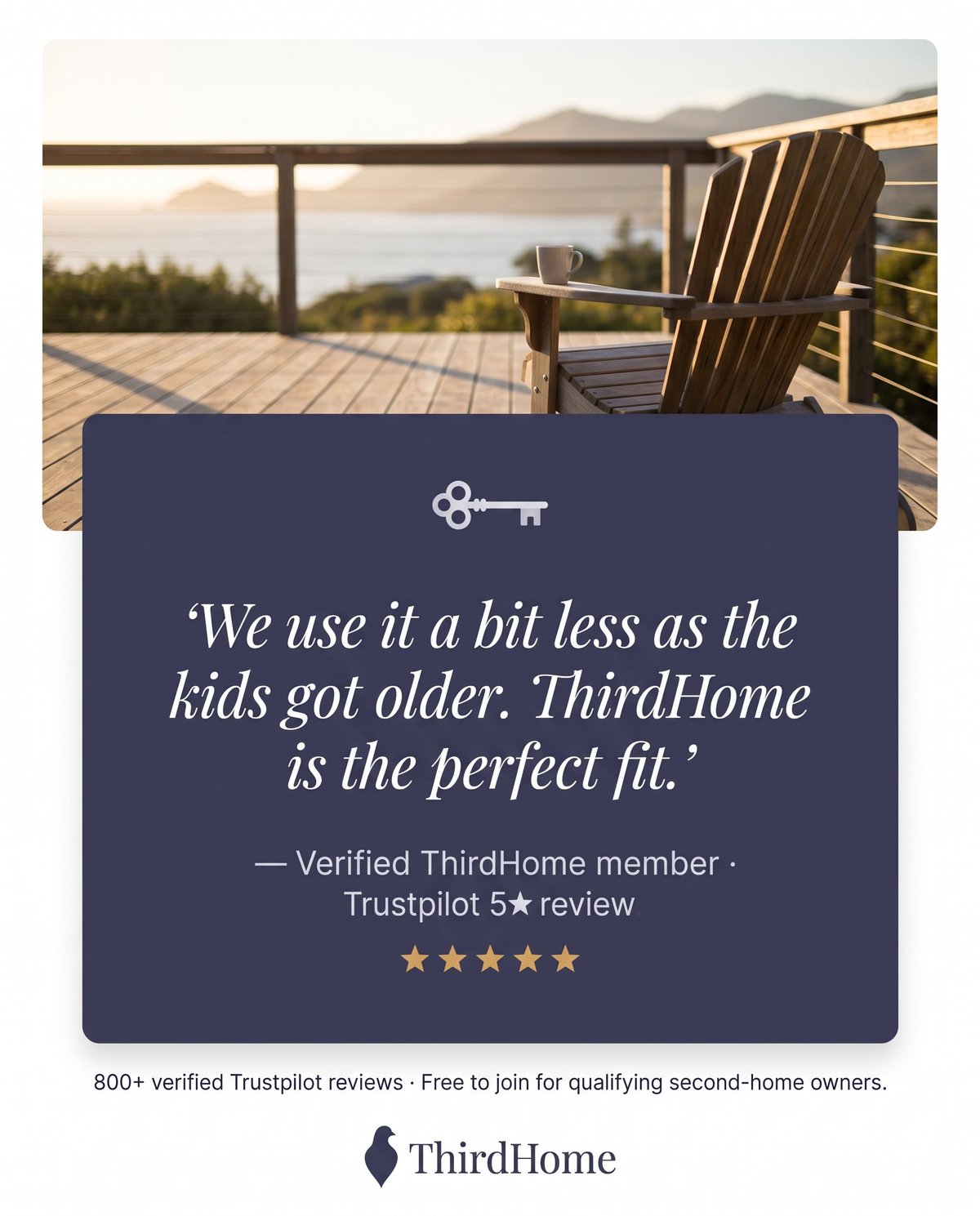
"We use it a bit less as the kids got older. We wanted to figure out monetizing it but not just renting it to whomever. ThirdHome is the perfect fit."
|
| 02 | The Veteran Frequent-Traveler | ~20% audience RETAIN & REFER |
60–75. Mostly retired. Member 5–10+ years. Names their advisor by first name. Already converted — the acquisition target isn't more of them, it's keeping them happy and turning them into referrers.
"We have travelled with ThirdHome for over 10 years and... able to travel for more than 10 weeks per year in high-end properties."
|
| 03 | The Branded-Residence / Fractional Owner | ~20% audience PARTNERSHIP CHANNEL |
45–65. Owns Hyatt VC, Vidanta, Marriott Vacation Club, or similar. Got a comp'd ThirdHome trial through their fractional. Doesn't see themselves as a "second-home owner" the way Persona 1 does. Acquisition channel is partnerships and in-resort placements, not paid social.
"I am a timeshare owner and was given a free trial membership and 7 keys. I'm actually contemplating becoming a full paid member."
|
| 04 | The Multi-Gen Family Trip Planner | ~15% audience CONCRETE VALUE |
45–60. The de facto family trip organizer. Books for 8–14 people across three generations. Hotels can't fit them. Airbnb at scale is a coin flip. Luxury villas direct rent for $25–50K/week. ThirdHome's 5+ bedroom curated inventory at exchange-fee pricing solves the math AND the trust.
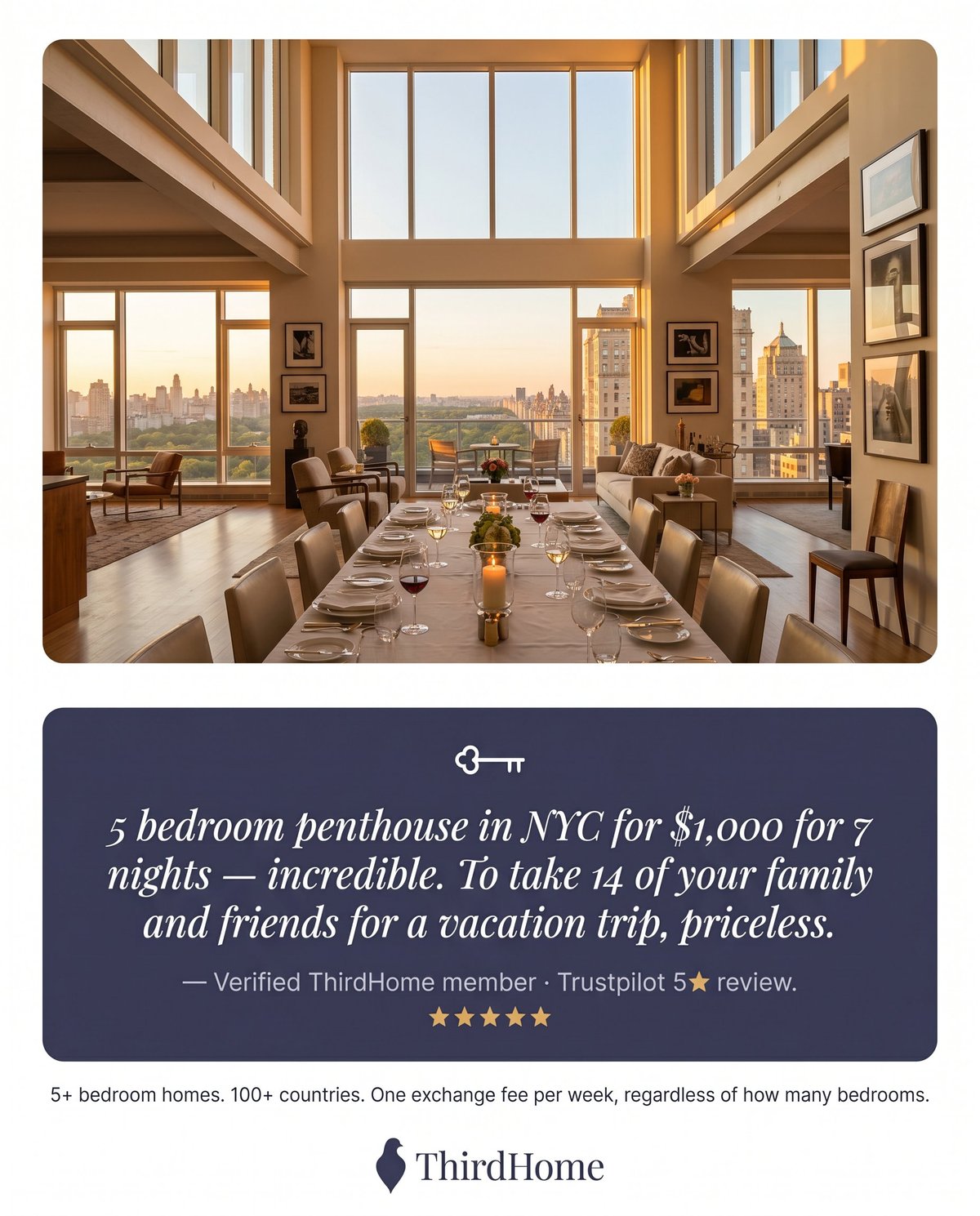
"5 bedroom penthouse in NYC for $1,000 for 7 nights — incredible. To take 14 of your family and friends for a vacation trip, priceless."
|
| 05 | The International Sophisticate | ~10% audience TOP-OF-FUNNEL BRAND |
50–70. Multiple second homes, often including Europe. Travels constantly. Has heard of home exchange and dismissed it. Other home-swap platforms put them in someone's lived-in apartment with kids' toys and family photos. Wants curated, refined, decidedly not someone else's life.
"Above the standard home exchange experience."
|
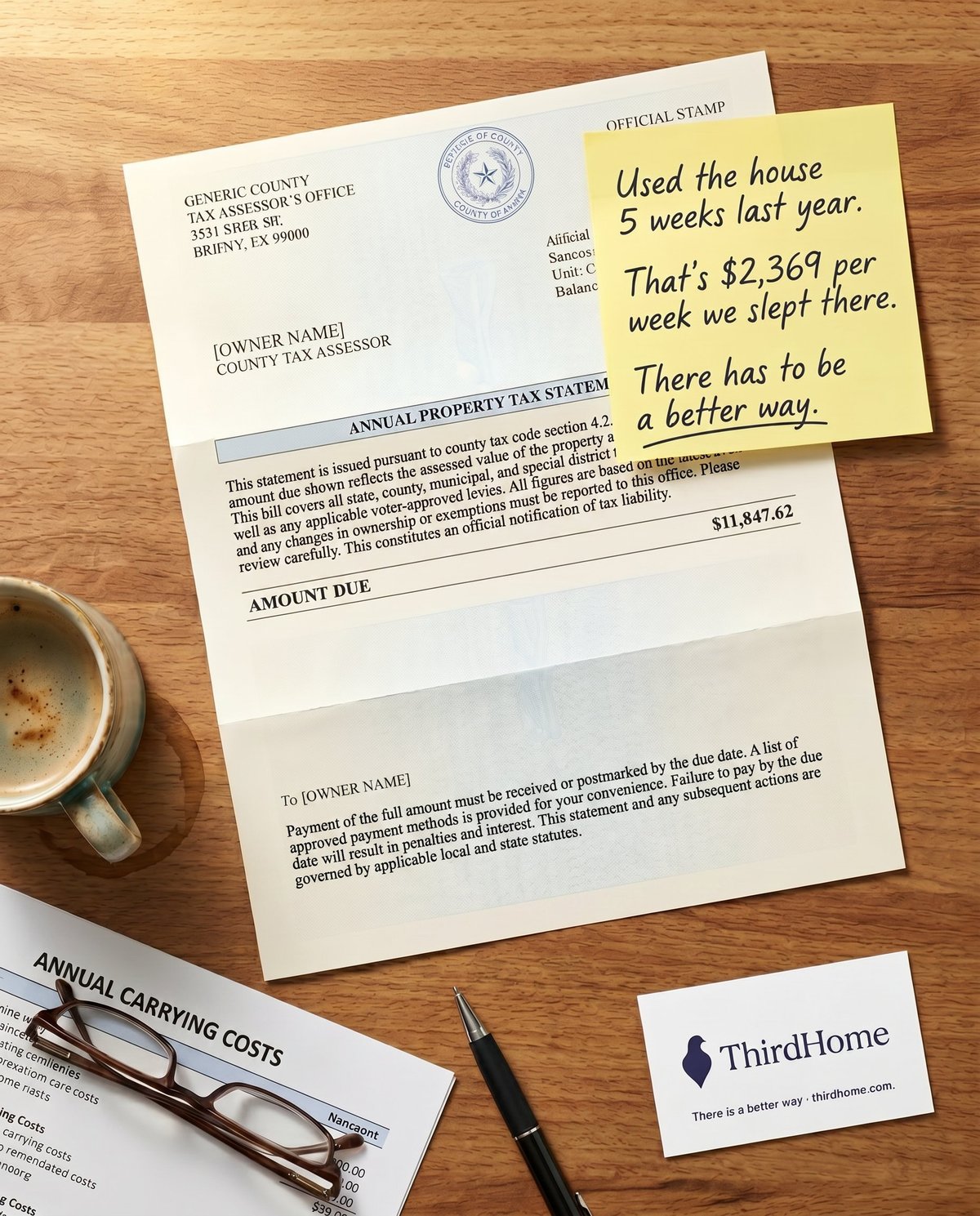
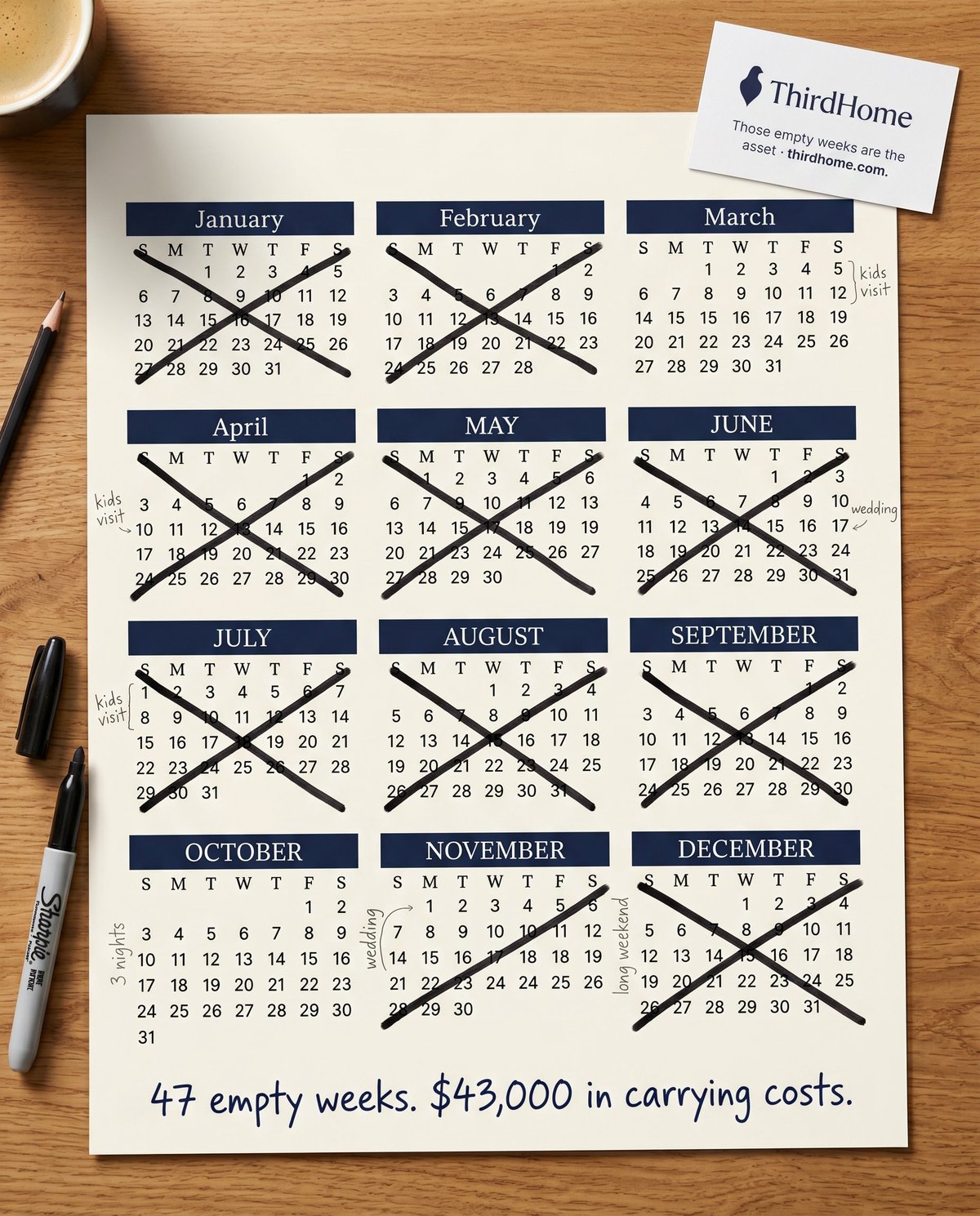
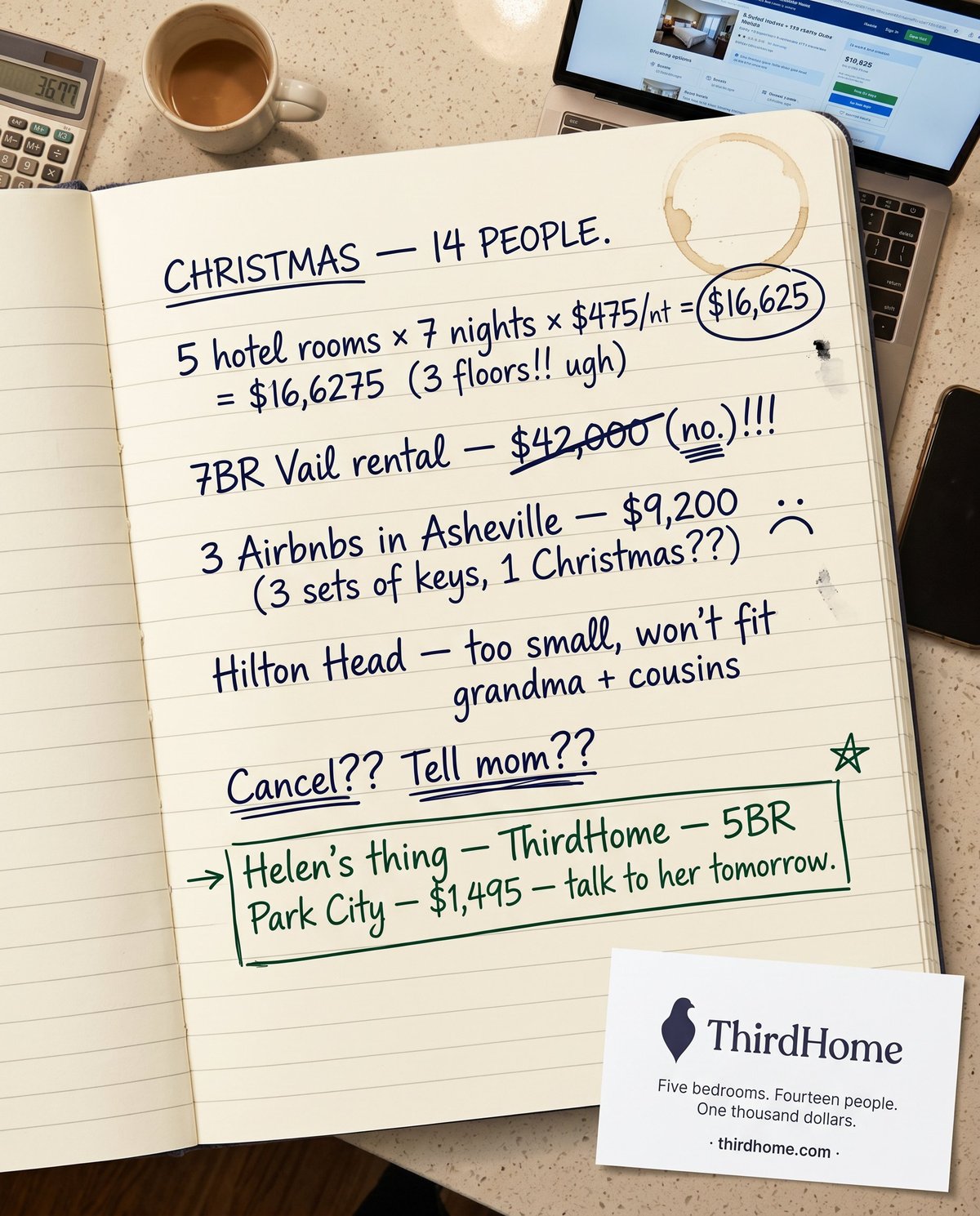
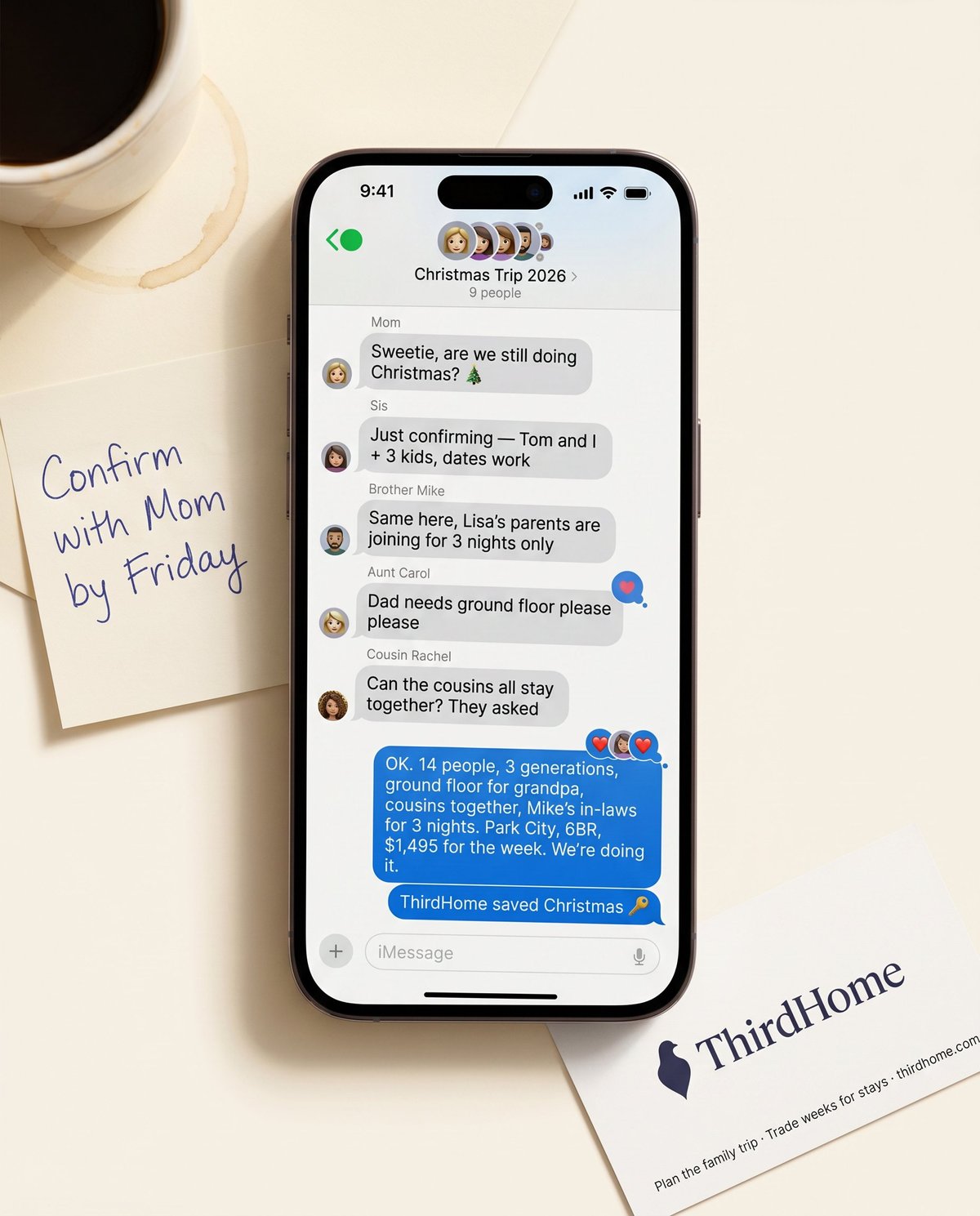
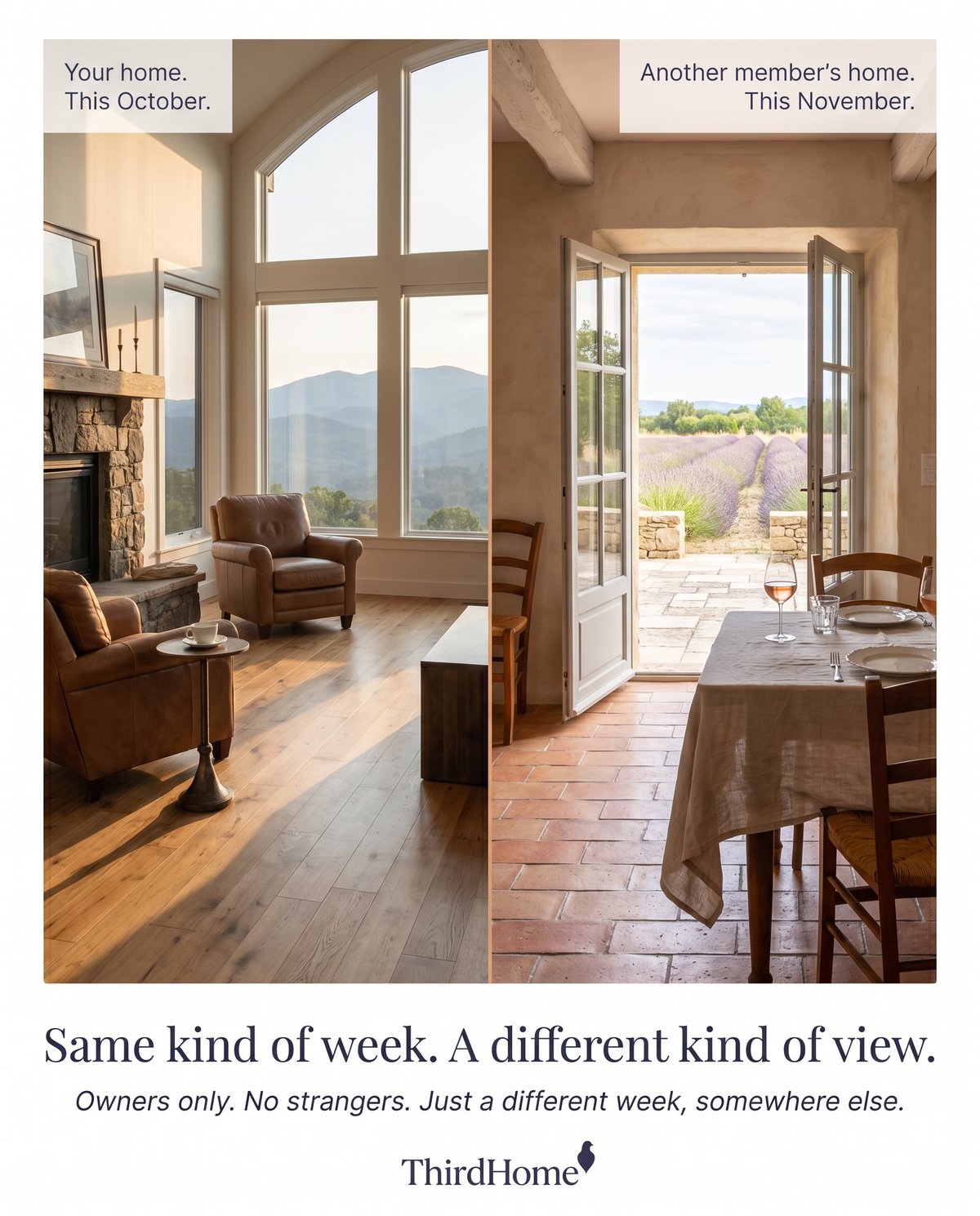
The Unicorn assessment surfaced ten visual style buckets ThirdHome reacted strongly to. The library is organized as a matrix: each style runs against each persona, with four message angles per cell. That's the production target by month three. Eight wave-one ads are produced and visible below — four for the Empty-Nest persona, four for Multi-Gen, balanced 50/50 between luxury polish and pattern interrupt. AI production is the only way to ship at this volume against $127K/month Meta spend.
"You own a second home. Most people see a property. You're holding a passport."
"Last year you spent $X on vacations. You also paid $Y on a second home that sat empty 40 weeks. There is another way."
"Your second home is wonderful. There are 30,000 others. You only have to share one week."
"Real member quote, real photo, real numbers. The verbatim language is the hook."
Wave one · already produced · ready to ship week one
Eight ads across the two priority personas, four per persona — two down-the-middle luxury brand ads and two pattern-interrupt outside-the-box concepts. The 50/50 split is intentional: the luxury ads convert warmer audiences and signal brand authority, the pattern interrupts win cold-traffic scroll-stop. Both halves of the matrix run side by side in the testing lab, with kill points enforced.
Wealthy second-home owners take 60 to 90 days to commit to anything. They don't fill out a form because of one ad. They fill out a form because the third ad answered an objection the first one raised, the fifth ad showed a member who looked like them, the seventh ad happened to land in a week when their property tax bill arrived, and the eighth ad was the math finally cleaner than they could ignore. The current Meta account treats every impression like it's the conversion impression. It isn't. It's a touchpoint inside a sequence — and the sequence is what gets us to ten thousand SQLs.
Full-funnel messaging maps every documented objection to a content asset, repurposes that asset into ad creative, and stacks the creative into time-and-engagement-based retargeting audiences. A prospect who first saw a pain-hook ad on day zero sees the objection-handler content on day seven, the math on day twenty-one, the member voice on day forty-five, and the soft "schedule a call" on day sixty. Each touch is the next sentence in a conversation, not a fresh first impression. This is what direct response gets wrong about luxury buyers — and what fixes the math.
First impression. The prospect doesn't know ThirdHome exists. The job of TOF creative isn't to convert — it's to plant a strong, brand-aligned mental hook the prospect remembers when retargeting catches up to them in the next 30 days.
The prospect saw the first ad. Now they have questions — the same eight or ten questions every prospect asks. Each question gets a content asset. Each asset becomes 4–6 ads. The math goes from "we need volume" to "we need depth on a finite list of objections."
The prospect knows the product. They've answered most of their own questions. What's missing is final proof — peers like them, math they can put against their own situation, and a soft, brand-aligned ask. The job of BOF is the SQL submission with link.
Eight specific objections every slow buyer raises before they SQL. Each one becomes a content asset, each content asset becomes ad creative. One piece of content = four to six ads. This is the structural fix to "creative refresh too slow" — the math finally works at $127K/month spend because we're producing creative variations, not new concepts every week.
| Objection | Content Asset | Becomes Ad Creative |
|---|---|---|
| "I'll have to give up my home for nothing in return." | Article: The Math of a Home Exchange — How Members Average 4–5 Trips a Year on Two Weeks Listed | Carousel breakdown of the math · single-stat hero ads · 60-second video explainer |
| "Strangers will damage my home." | Video: Inside the Vetting — How ThirdHome Verifies Every Member | Video pull-quotes · $5M host-protection callout ads · verbatim "not a darn thing went missing" testimonials |
| "How is this different from Airbnb / VRBO?" | Article: Owners Only — The Five Differences Between Home Exchange and Vacation Rental | Side-by-side comparison ads · "We don't rent to renters" single-claim ads · format-parody Zillow listings |
| "What if I can't find availability?" | Tool: Live Availability Calendar — What's Bookable Right Now | Inventory-density ads · seasonal-availability ads · "30,000 properties / 100+ countries" stat hero |
| "Is this a timeshare?" | Article: What ThirdHome Is NOT — And Why That Matters | Negative-space ads · "not a timeshare" pull-quote ads · transparency-first framing |
| "Are the homes really as nice as the photos?" | Photo essay: Inside Twelve Member Homes — Real Properties, Real Photos | Carousel reveal ads · single-property walkthrough video · "Designer furniture, original artwork" verbatim |
| "What if grandparents can't do stairs?" Multi-Gen specific |
Article: Designing the Multi-Gen Trip — Accessibility Filters and What to Ask | Filter-feature ads · ground-floor primary suite walkthroughs · "Sleeps 14 with no stairs" hero |
| "Is the membership worth $295?" | Calculator: Your Personal Savings Estimate · interactive tool | Cost-savings ads with personal-input hooks · "$35,000 home for $1,500" verbatim · breakeven math hero |
Five audiences. Each defined by engagement depth and time since first touch. Each shown a creative bundle calibrated to that point in the consideration cycle. The prospect doesn't see the same ad twice in a row — they see the next ad in the conversation. Frequency caps prevent fatigue. Audience exclusions prevent overlap.
Every full-funnel content asset is also Carissa's WordPress build queue, and every retargeting audience is configured in week three alongside the Andromeda restructure. Nothing here is hypothetical. The math, the architecture, and the build sequence are concrete. The objection map gets locked against ThirdHome's internal data in week one — sales transcripts and member-services emails will surface objections the public TrustPilot reviews missed.
Two personas, three formats each — sales page, advertorial, listicle. Each format hits the same persona from a different angle: the sales page does pain-to-solution, the advertorial does first-person narrative, the listicle does educational reframe. Six pages give us six creative directions to A/B against each persona's audience, isolating which structure converts best for whom.
Each page is built in ThirdHome's existing brand register, with the SQL link-submission qualification gate built in. Each routes to the same SQL form. Each fires a custom conversion event tagged with persona × format attribution so Andromeda learns which combination converts best.
A note on Persona 03 (Branded-Residence). Branded-residence members come through partnership channels — comp'd trials inside Hyatt VC, Vidanta, Marriott Vacation Club, Grand Solmar. That funnel needs in-resort placements, partner emails, and trial-conversion sequences, not paid-social LPs. ThirdHome's stated paid-acquisition priority is whole-home owners. Persona 03 is documented in the persona architecture above for internal channel intelligence and future partnership-channel investment, but is intentionally not in this paid-acquisition LP set.
Three formats hitting the same persona from different angles. The pain-to-solution sales page is the workhorse for cold paid social. The first-person advertorial absorbs the longer-consideration traffic from premium publisher placements. The listicle does the patient educational reframe for organic and retargeting.
Pain-to-solution sales page. Hero punches the empty-nester reality, cost callout shows $8K/wk vs $695/wk math, real verbatim TrustPilot quotes throughout. Fastest-converting structure for cold paid traffic.
First-person narrative from an empty-nester narrator. Single-column editorial, drop-cap lede, the honest math reveal, the friend-at-dinner moment, year-one experience in Tuscany / Paris / Cotswolds for under $4,400 total.
Educational magazine-style reframe. 7 reasons in a 3-column grid with sticky big numerals + body + sticky margin pull-quotes. Embedded cost-comparison cards in reasons 1, 3, 5. Mid-CTA after reason 3.
The most concrete value proof in the entire customer voice library: a verified five-bedroom NYC penthouse for fourteen people across seven nights, $1,000. Three formats again — the math-driven sales page, Sarah's first-person Christmas-booking story, and the seven-rules listicle for big-family planners.
Pain-to-solution sales page. Hero punches the hotel-block math, cost callout shows $15.4K vs $1K for fourteen people, properties grid skews to 5+ bedrooms with sleeping capacity called out. Five objections specific to family-trip planners.
First-person narrative from a Sarah-style family planner. The hotel-block-pricing horror, the Airbnb-spread-near-miss, the friend-at-brunch moment, the actual Park City Christmas at $1,495 with three generations under one roof.
Educational reframe for big-family planners. Hotel-block math → Airbnb spread risk → urgency window → catalogue intro → geometry payoff → concierge difference → twenty-year-memory legacy. Embedded cost cards in reasons 1, 3, 5.
The current US account is fragmented into multiple narrow-targeted ad sets that pre-date Andromeda. The restructure consolidates into three persona-themed campaigns, a creative testing lab, and a retargeting campaign — total of five. Each persona campaign runs 15–20 ads on broad targeting, mixed format, optimized for SQL with link submission. The math gets cleaner. The signal back to Andromeda gets stronger. The CPA drops.
| Campaign | Budget | Purpose |
|---|---|---|
| Persona 01 · Empty-Nest ASC | 25% | 15–20 ads. Mixed format. Broad targeting USA 50–75. Optimized for SQL with link submission. Routes to Empty-Nest LP set (sales / advertorial / listicle). |
| Persona 04 · Multi-Gen ASC | 25% | 15–20 ads. Mixed format. Broad targeting USA 38–60. Optimized for SQL. Routes to Multi-Gen LP set. Seasonal flighting around Christmas / Spring Break / family milestone windows. |
| Persona 03 · Branded-Residence (Partnership) | REVIEW | Currently inside the paid social budget. Recommended migration to partnership-channel funnel — in-resort placements at Hyatt VC / Vidanta / Marriott VC, partner email, trial-to-paid sequences. Frees ~25% of paid social for Persona 1 and 4 scaling. To be discussed week one. |
| Creative Testing Lab | 15% | Ten new concepts per week. After 7 days and 1,000 reach, winners graduate to persona campaigns, losers get cut. The pipeline that keeps the persona campaigns from going stale. |
| Retargeting + Warm Audiences | 10% | Historical SQL list seeded for 1–3% lookalikes — currently unused, the highest-quality signal in the account. Trustpilot reviewer audiences. Video viewers. Form-abandoners. |
EMEA tier-2 geographies (Italy, France, Spain, Germany) get separate ad accounts during the international takeover in month five. Until then, EMEA stays in the existing structure to avoid disrupting in-flight campaigns. The audit recommendation for separation is correct; it gets executed once US trust is established.
The +30% YoY SQL growth mandate is the number that defines the engagement. Against the 2024 baseline of 7,281 SQLs (the most recent confirmed annual figure in the Unicorn brief), that's roughly 2,200 incremental SQLs annually. With Meta carrying about half the load on a typical year, that's an additional ~90 SQLs per month from Meta against current run-rate. The persona-first architecture exists to make those incremental SQLs available without proportional spend increases — and validating the actual current-year baseline against ThirdHome's internal Looker data is week-one work, since the public brief is a year stale.
| Geography | 2026 YTD CPA | Target by Month 6 |
|---|---|---|
| United States | $670 | $475–$525 (–25 to –30%) |
| Australia | $893 | Out of scope |
| EMEA Overall | $1,700 | $1,050–$1,200 (month 5+ takeover) |
| Italy / France | ~$2,000 | $1,200–$1,400 (month 5+ takeover) |
If we don't hit those, we don't scale. We diagnose. The $2.5M annual budget gives us the room to be patient — patient now creates a much bigger machine in months 4–12.
Day-thirty deliverable: a measurable bend in the SQL trend that's been declining over the last forty days. Day-ninety deliverable: a documented win/loss creative library, a clean Andromeda-native US account, and a scaling brief for months 4–12.
Eight specific actions that ship inside week one. Half are stop-the-bleed (the audit findings nobody pulled). Half are foundation moves that compound over months — the SQL list seeded as lookalikes, the link-submission custom conversion, the creative-tracking spreadsheet that fixes the recurring "we lose track of what worked" frustration.
| # | Quick Win | Why It Matters |
|---|---|---|
| 01 | Pause every ad with CPA 4× account average | Stop the bleed Day 1. Unicorn audit already surfaced these — they're still running. |
| 02 | Upload the historical SQL list | Multiple years of converted-customer data is the highest-quality signal in the account, currently unused. Seeds 1–3% lookalikes. |
| 03 | Configure SQL-with-link-submission as a custom conversion | The thing we're optimizing for has to be measurable distinctly from MQLs. Right now it isn't. |
| 04 | Route 10% of next week's spend through the first LP | Proof of concept on link-submission rate before full restructure. Empty-Nest LP A/B against Meta lead form. |
| 05 | Pull every existing TrustPilot review into a creative-asset library | Free social proof, immediately ready for testimonial-format ads. The 813 reviews already analyzed are the starting point. |
| 06 | Schedule the standing twice-weekly sales feedback drop-in | Plug into existing rhythm. Don't create new ceremony. Listen for two weeks before contributing. |
| 07 | Build the first creative-tracking spreadsheet | Direct fix to "we lose track of what worked 6 months later." Every concept logged with status — testing / scaling / killed / paused. Quarterly creative archives. |
| 08 | Test partnership ads format on Meta with one creator | They didn't know this format existed. Introducing it is a credibility moment and the format itself converts the niche audience well. |
The Unicorn assessment surfaced specific frustrations from past agency relationships. Each one has a structural fix in this engagement. None of them are addressed by saying "we'll do better." They're addressed by changing the operating model.
| Past Burn | Direct Solution |
|---|---|
| "Beautiful assets get built, tested, then lost track of 6 months later." | Creative-tracking spreadsheet built Week 1 (Quick-Win #7). Every concept logged with status — testing / scaling / killed / paused. Quarterly creative archives. The "we don't know what we already tried" problem dies the first week. |
| "Multiple vendors creating communication breakdowns." | One person owns paid social end-to-end. Damien is the consulting voice during transition. Carissa builds in-house. The landing page consultant owns search LPs. Clear lanes. No overlap. No "who's doing what again?" |
| "European ad performance lackluster despite in-market contractors." | EMEA gets earned, not promised. Months 1–4 = US proof. Month 5 = takeover with separate ad accounts and native-localized AI creative, not translated copy. The current EMEA contractor stays through month four. |
| "Partnership marketing hit-or-miss because audience is a narrow niche." | Don't optimize for follower count. Optimize for second-home-owner overlap. One creator test in Quick-Win #8 with a hand-picked partner. Win/loss documented before scaling. |
| "Creative refresh cadence too slow — 4–6 weeks." | AI production pipeline shifts cadence to weekly by month 2. The whole engagement is built around making this sustainable. Without AI production, the math doesn't work at $127K/month spend. |
The 813 TrustPilot reviews that informed the persona work are the public-facing tip of a much bigger data set. The much more valuable insight lives inside ThirdHome already — sales call transcripts, member-services email threads, the twice-weekly feedback calls, and the cancellation conversations. With access to that, the creative pipeline becomes self-feeding. This is the moat no agency without internal data access can replicate.
| Phase | What Gets Built |
|---|---|
| Week 01 · Access | Read access to HubSpot call recordings, sales-team Slack channels, and member-services email queue. Same access pattern Damien already has. Listen-only, no operational interference. |
| Week 02 · Pipeline | LLM-based analysis pipeline across 200+ recent sales calls and 500+ member-services emails. Extract real objection language, real benefit articulations, real persona signals. Output is a continuously-refreshed creative briefing document. |
| Ongoing · Rhythm | The existing twice-weekly feedback calls become structured creative inputs. Every call generates 3–5 new ad concepts directly from the language sales heard that week. Dan and Amy Jo see the throughline: the call → the concept → the test result. |
| Output · The Moat | A creative pipeline that doesn't dry up. Direct fix to the "creative refresh too slow" frustration. With insight mined from sales calls weekly, the pipeline is unending — and no agency without internal data access can replicate it. |
I don't replace anyone on this list. I sit between them and make the system run faster. Damien stays through the transition. Carissa keeps building. The landing page consultant keeps owning paid search LPs. The sales team keeps the lead-quality signal. Nothing here disrupts existing relationships — every one of them gets stronger because the pipeline that flows through them is sharper.
| Person | Role | How I Work With Them |
|---|---|---|
| Dan | CRO · SQL accountability | Short frequent check-ins, his stated preference. Big-picture alignment. SQL trend ownership weekly. |
| Amy Jo | Marketing Lead · brand integrity | Creative briefs reviewed before production. Brand integrity on every concept that ships. Ad-review calls twice monthly minimum. |
| Carissa | Canva · WordPress · CRM | I brief, she builds. AI accelerates her output, doesn't replace it. Weekly cadence — Monday brief, Friday review. |
| Damien | Existing media buyer · collaborator | Weekly handoff calls Months 1–2. Ongoing collaborator on platform tribal knowledge. Respected, not displaced. |
| Landing Page Consultant | Paid search LPs | Monthly sync. They own search LPs. I own paid social and display LPs. Clean lane separation. |
| Sales team | Lead-quality signal | Treat input as anecdotal signal, not directive. Exactly as Dan described it. Pattern-spotting across feedback calls turns into creative briefs. |
I do not need answers to these before week one. I need answers to these during week one. Each of these shapes the priorities of the first thirty days. Each of these is an invitation to align before the engagement gets expensive to redirect.
The SQL trend over the last forty days — what's your gut on what's driving the decline? Creative, audience, season, or external?
The five personas — Empty-Nest, Veteran, Branded-Residence, Multi-Gen, International. Does that match how Carissa and the sales team describe who actually books a call?
The link-submission requirement — at what conversion rate from form-start to link-submission would you consider a landing page successful?
Damien — what does the right collaboration with him look like through the first sixty days, in your view?
EMEA in month five — what would prove to you that I've earned the right to take it on?
The twice-weekly feedback calls — when would you want me to start sitting in?
Creative volume — when you said AI creative production was the differentiator, what was the specific thing you wanted that you weren't getting before?
If something is urgent outside of hours, I respond immediately. If it can wait, we build a plan together. You'll never feel like you're chasing me. I think about ThirdHome's customer between every call — the empty-nest mom looking at the calendar with forty weeks of nothing on it, the fractional owner who doesn't know there's a better way, the family planner trying to fit fourteen people into one rental that doesn't exist. That's where the creative comes from. And that's the kind of partner I want to be.